


EXPERIMENTA SPECIAL EDITION @ KOCHI BIENNALE
|
In collaboration with the Kochi Biennale Foundation, Experimenta India presents a Special Edition of EXPERIMENTA at the Kochi Muziris Biennale from Jan 5-10, 2026, 7pm at the Pavilion, Bastion Bungalow, Fort Kochi. 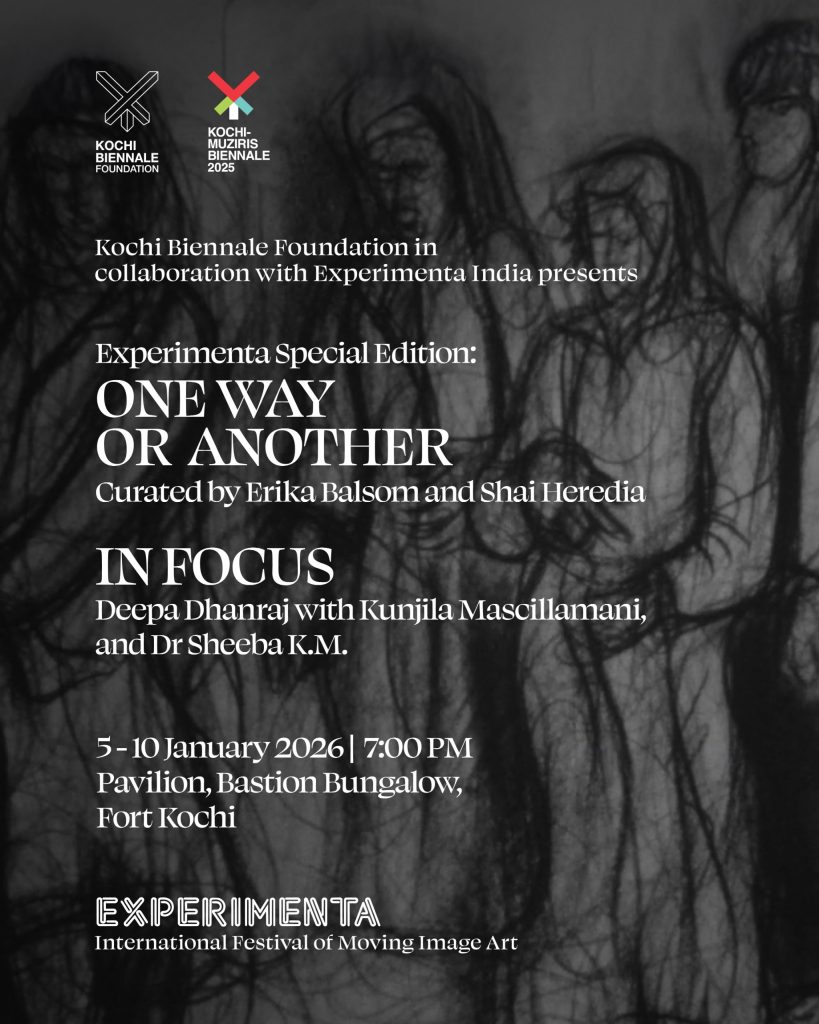 ONE WAY OR ANOTHER IN FOCUS
MONDAY JAN 5TH These three very different films experiment with form to reflect on what it means to make an image in situations of gender-based and/or colonial oppression. In each case, a confrontation with dominant images is accompanied by the production of radical alternatives that never forsake the possibility of pleasure. Untitled 77-A Nice Coloured Girls Miss Universo en el Perú | Miss Universe in Peru TUESDAY JAN 6th This program will be followed by a conversation between Deepa Dhanraj and Dr.Sheeba K.M, Professor of History at Sree Sankaracharya University of Sanskrit, Kalady, Kerala Tambaku Chakila Oob Aali | Tobacco Embers Tambaku Chaakila Oob Ali documents, re-enacts, and takes forward one of the largest movements of unorganized labor of its time and context, which sparked unionizing processes across India throughout the 1980s. In the spirit of mobilizing for the leftist labor and the women’s movements the Yugantar collective spent four months with female tobacco factory workers in Nipani, Karnataka in India, listening to their accounts of exploitative working conditions, discussing strategies for unionizing and steps to broaden solidarities for strike actions, and filming previously unseen circumstances inside the factories. A powerful example of a feminist third cinema. Idhi Katha Matramena | Is This Just a Story? This short improvised fiction film is affectionately called Yugantar’s ‘hit’ film. Provoked by an urgency to broaden discourses and political practice on domestic violence, Yugantar collaborated with the research and feminist activist collective Stree Shakhti Sanghatana. Through an intense period of a consciousness raising style sharing of their own varied and multi-layered experiences of domestic violence, members of both collectives created a script that focuses on isolation and depression while also developing a complex female character in the process of articulating her situation and finding support in female friendship. Filmed within one week, with limited resources and enacted by members of the collectives, the film’s capacity to speak to multiple experiences appears equally strong today. WEDNESDAY JAN 7th ONE WAY OR ANOTHER: POSSESSION (94mins) In what has been hailed as a path-breaking cinema vérité exploration, this film offers the viewer a deep understanding of the many exploitations surrounding the lives of women and the subversive ways through which they navigate their worlds. Eyes of Stone THURSDAY JAN 8th Asanghadithar | The Unorganised Asangadithar (The Unorganised) was the first film to highlight the undocumented struggle of saleswomen in the director’s city for access to toilets at work. This historic fight, the first in the country to raise such a demand, was led solely by women, as male workers simply urinated by the roadside, a practice socially ‘allowed’ for them. Under the leadership of Viji, a tailor who worked in S M Street in Calicut, Keralam, saleswomen came together and fought for their basic right to urinate and to work with dignity. Viji formed a collective called Penkoottu (Female Friendship) and went on to fight for several other rights including fair pay and reasonable working hours. This screening will be followed by a conversation between Deepa Dhanraj and Kunjila Mascillamani.
ONE WAY OR ANOTHER: BATTLEGROUND (62min) The image is a battleground. This program features fierce contestations of the ways in which women are typically pictured, whether it involves sexuality, family, or labour. In each case, a collaboration between the filmmaker and her subjects results in unprecedented depictions of female experience. Onanism Susana Mi aporte | My contribution SATURDAY JAN 10th ONE WAY OR ANOTHER: LETTERS FROM LEBANON AND PALESTINE (78min) These three works speak to histories of exile, solidarity, and struggle in Lebanon and Palestine, with a particular attention to the bonds between women and the possibilities of epistolary expression. Les Femmes palestiniennes | Palestinian Women Measures of Distance Letter from Beirut BIOS Erika Balsom is Reader in Film Studies at King’s College London. She is the author of four books, including After Uniqueness: A History of Film and Video Art in Circulation (Columbia University Press, 2017) and TEN SKIES (Fireflies Press, 2021, shortlisted for the Kraszna Krausz prize). Her writing has appeared in publications such as Cahiers du cinéma, e-flux journal, and New Left Review. With Hila Peleg, she is the co-curator of No Master Territories: Feminist Worldmaking and the Moving Image (HKW Berlin/Museum of Modern Art Warsaw, 2022-23) and co-editor of the books Feminist Worldmaking and the Moving Image(2022) and Documentary Across Disciplines (2016), both published by MIT Press. Shai Heredia is a filmmaker, curator, and founding director of Experimenta, the moving image art biennial of India. She has curated film programs and exhibitions worldwide. Heredia has co-directed I Am Micro (2012) and An Old Dog’s Diary (2015). Both films have exhibited at international film festivals and art venues, and won awards including a National Film Award and a BFI London Film Festival award. Heredia has contributed to journals such as The Moving Image Review and Art Journal and PUBLIC and was the co- editor of the Loud Mess issue of NANG magazine. Her latest book “One Film at a Time” has been published by Arsenal Institut for Film and Video Art. Heredia is currently the co-curator of Berlinale Forum Expanded. She is based in Bangalore, India where she teaches film and contemporary art practice at the Srishti Manipal Institute of Art, Design and Technology. Deepa Dhanraj is an award-winning filmmaker and writer. She has been part of the women’s movement in India since 1980. She was one of the founding members of Yugantar, a feminist film collective that made a series of films in the early 1980s documenting rural and urban women’s movements for labor rights and autonomy. The Yugantar films were recently restored by the Arsenal Institute for Film and Video Art and screened at the Berlinale in 2019. Focused on feminist politics, Deepa’s extensive filmography spans three decades and subjects including population control programs in India, Muslim women’s courts, community efforts to combat HIV/AIDS, and more. She has a special interest in education and has worked closely with government schools to create pedagogy suited for problems faced by first-generation learners who come from Dalit and Adivasi communities. Dr. Sheeba K.M. is Professor of History and Coordinator of Dakshayani Velayudhan Centre for Women’s Studies, as well as of Kerala Institute for Gender Equity (Centre of Excellence of Kerala State Higher Education Council) at Sree Sankaracharya University of Sanskrit, Kalady. She received her MPhil and PhD Degrees from the Jawaharlal Nehru University, New Delhi. She has been teaching Post Graduate and PhD Programmes and has produced three PhDs with her supervision. Her Project with the Centre for Women’s Development Studies, New Delhi was on the Ambedkar Colonies of Ernakulam District. She is the recipient of the Wiscomp Saahas National Award for fostering gender sensitive practices in academic institutions. She has published on Kerala’s gendered pasts, sexuality and movements. Apart from delivering invited lectures, she is a regular resource person at Kerala, Mahatma Gandhi, Calicut, and Kannur Universities as well as at the Kerala Institute of Local Administration (KILA). She has been the editor of Sanghaditha, the feminist monthly in Malayalam from 2015 to 2023 Kunjila Mascillamani is a writer-director from India and a postgraduate in Direction and Screenplay Writing from Satyajit Ray Film and Television Institute (SRFTI). “Asanghadithar” (The Unorganised), part of the anthology “Freedom Fight” (SonyLIV), received acclaim for its blend of humour and political urgency. “Freedom Fight” was awarded a Special Jury Mention at the 2023 Keralam State Film Awards. In 2024, “Asanghadithar” was added to the University of Calicut’s BA curriculum. Mascillamani’s accolades include the Laadli Media Award and Toto Funds the Arts Award. Mascillamani’s debut feature project, “Guptam,” currently in development, is produced by Payal Kapadia, Jeo Baby, and actor Kani Kusruti. The project has been selected for the Asian Project Market, Busan, NFDC Co-Production Market, Keralam Film Market, Bangalore Literature Festival, and CinéV-CHD Projects Market. Mascillamani was selected for the Toronto International Film Festival’s Directors’ Lab in 2025. https://www.instagram.com/experimentaindia/ |